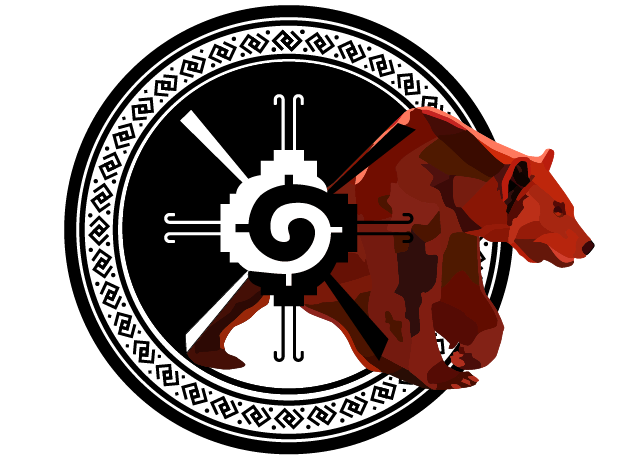

The name of this step, Teochiwa, from the Aztec/toltec language Nahuatl, translates as devotion and breaks down into two meanings: teo means God, and chiwa is to make. One could say it is the devotion needed to achieve one’s own divinity. It’s not, however, devotion as western religion sees it, as worship and prayer, and it is not necessarily aimed at an outward being or deity, either. Devotion flourishes within, to make of oneself a god (small g), to find and use one’s own divinity here and now.
The word teo also translates as energy and indeed, one requires energy to make oneself the best one can be, perhaps a god. One’s relationship with energy and its appropriate manipulation becomes functional and dynamic; it is not something one seeks on one’s knees. This is the kind of “devotion” that built the pyramids…but wait, I’m getting ahead of myself.
The “process and step” refer to the toltec way, aka the Black & Red Ink, and the teaching comes from ancient toltec/Aztec artifacts, ancient references created by toltec hands 500 to 7000 years ago. One of our primary references for this article, and our forthcoming book, is a compilation of many ancient sources, such as the Florentine Codex, The Chilam Balam and the Vatican Codex, all of which stem from the Conquest of Mexico by Spain in 1521:
Diaz, Frank, Kinam, El Poder del Equilibrio, antiguas técnicas toltecas, Editorial Alba, 2002; (Kinam, The Power of Equilibrium), ancient toltec techniques, Editorial Alba, 2002
In the study and practice of things toltec the ancient is very much alive in the modern. The toltec way moves constantly whether we are aware of it or not. Our experience with this step is to have been learning and applying the knowledge before we knew it was an actual “step in a process,” set out hundreds of years ago to boot. This experience taught us the tradition dances whether or not we are in step. Our discovery of the ancient sources both explains the modern and affirms its validity. The toltec way is alive and well, dynamic one could say.
In Chapter 3: Teochiwa, author Diaz says the Spanish came to find many similarities to Catholic conventions, especially among the holy sacraments. Baptism, Communion, Confession, Marriage and Extreme Unction were and are a part of toltec life, long before the Spanish came. Each sacrament, however, has some similarities along with various differences to the Catholic versions. Baptism, for instance, features a fire devotion and water poured over the baby’s head. The toltec baptism also includes calling upon the infant’s spirit animal for guidance and protection, a convention quite common throughout the Americas, aka Turtle Island.
Communion was observed every 20 days, a month on the Aztec calendar, and served up by priests to individual participants. The difference came in the mindset of the culture, community,in how they lived the 20 days in between, and naturally so, considering different values and needs in attaining the necessities of life.
Confession, aside from the good that comes from coming clean, the perspective of sin was/is quite different. There was no attention given to Original Sin and all the issues that ensue from that concept, especially since sin is a curable problem. The toltec stance is that since we were originally divine, and being that we still are divine, it takes a lot of work to get it back. Confession was a relief that brought happiness and the will to change things, as opposed to punishments and labels.
Marriage was more about the education and the raising of the children – the future of the tribe, than the “happily ever after picket fence” myth. A common wedding lasted four days, with the couple spending lots of time alone. The ceremony revolved around invoking the four elements of Earth and the four winds, as well as seeking the will of the Creator.
Finally, there was Extreme Unction, death rites. At a time of dying, the priest was called to deliver the final rites. The awareness of death, however, is a core principle in the toltec cosmovision. To list the differences in the death journey would change the context of the article. Suffice it to say that this journey for a toltec relates more to the Tibetan or Egyptian way of understanding death, such as the Books of the Dead, than other religious backgrounds, like Christian or Jewish. Yet, all the religions, including toltec, seek heaven in the end.
Most of these conventions continue to this day, but the toltec way, never stale and rote, is ever-evolving. New knowledge about divinity has come into play now. We find that much of the toltec and other ancient reasoning holds current relevance in our lives.
For instance, there are two beliefs/concepts/theories coming from ancient times that we are all aware of, at some level. We’re pointing at freewill and the divinity within. Most of us have opinions and beliefs about these two ideas, in a thousand different, and mostly silent, corners of our lives and minds. While we know about these concepts to some extent, awareness of them ranges somewhere from polite agreement to great curiosity and eventually to living divinity in the flesh.
The idea that our Creator gave us free will, to do as we choose, is affirmed by most religions. It’s taught. What’s rare is for any religion to promote free will, or God-forbid, learn how to use that freedom to create better lives. Instead we’re taught how to comply, fit in, sacrifice, be scared and somewhat stupid at times. How long has this freedom and the lack of it been a human issue?
Toltecs embrace freedom, study it, crack it open, stretch it. Anything toltec you study will have the appreciation and development of that freedom built in.
Another ancient tidbit that finds confirmation in many religions, as well as within the newer genre of New Age beliefs and practices, is the concept of humans possessing divinity within. From the early Bible divinity within is explained in The Book of Saint Thomas, a book, by the way, edited out of the Bible a few hundred years ago. Most of us have heard, from some source or another, that we human beings all have a little piece of God inside. If humans were fully aware of that fact, what a Merry Christmas it would be.
The most current support for the “divinity within” concept comes from within the field of quantum physics. The idea is no longer considered a superstition. We’ll get into some of the science supporting that divinity in later articles, but the facts are pouring in about a field of energy within our reach that taps divine power.
Long before the Catholic Church came to Mexico we had baptism, communion, confession, marriage and death rites. While some of the rites have parallels with Catholic rites, there are some marked differences. For instance, original sin and its consequences are not in the toltec belief system. Sin is something, after all, that can be cured. The toltec relationship to death and the ancestors is also unique, a major dynamic in the toltec way, as you may come to see.
The toltec way of thinking developed in an imminently mystical environment. Instead of wars and wealth, the toltec turned to the wonders inside, exploring the hidden archives of consciousness, extracting enormous amounts of information about the energy that animates us. For a toltec who believes deeply in the unlimited potentials of humanity, this information is infinitely practical and useful, and when information is used in that way, it turns to knowledge, as in the “Knowledge is Power” way of thinking.
The emphasis on practical functionality, as opposed to theories, makes this devotion more about using energy wisely than about seeking deities for favor or succor. Indeed, if you walk Teochiwa, you’ll wind up seeking, learning and mastering various states of consciousness, for optimal performance in your chosen role, whatever that may be.
Our forthcoming book, the Black & Red Ink, A Course in Freedom sees this divine spark as a path to enlightenment and empowerment. It’s not something you smile nicely about in religious gatherings, while holding immense amounts of doubt about it, in denial. It’s a challenge you take, worthy of our best efforts, worthy of a warrior’s spirit. Most human beings, offered this freedom, won’t accept the discipline, and much less, give what it takes to spark the divinity within, and that’s OK. Each of us has the freedom to decide.
MAKE ART

 The Black & Red Ink
Thank You
LikeLike
Thank you, Hermano! For reading it!
LikeLike